By Freddie Sankey · Former Royal Marines officer
What a Grade 1 scramble feels like if you're scared of heights
Almost everyone feels something on exposed ground. Here is what the fear is doing, when it shows up, and the handful of things that make it manageable.
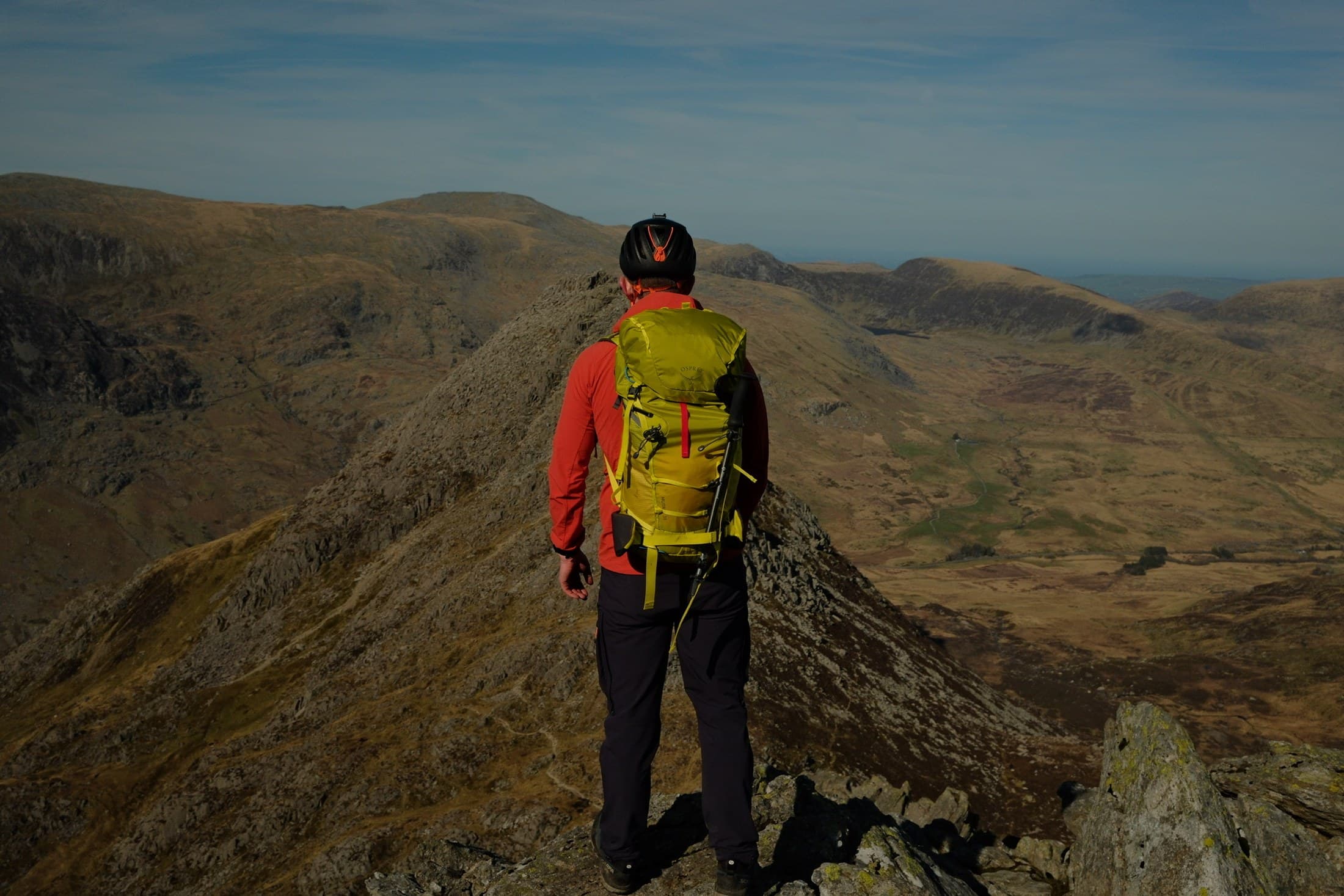
The question comes up before almost every scrambling weekend, usually by email, usually phrased as an apology. I want to do this but I'm not great with heights. Is that a problem?
Short answer: probably not. Longer answer is worth reading, because the fear is real, it behaves in fairly predictable ways, and most of what people imagine about scrambling is not what scrambling is.
Height and exposure are two different things
Standing on a wide grassy summit at 1,000 metres, most people feel nothing at all. Standing on a two-metre wall with a drop on one side, plenty of people feel their stomach go. The altitude is irrelevant. What triggers the response is exposure: a drop close enough to your feet that your body registers it as consequence.
This matters because it tells you where on a route you will feel it. Not on the long ascent. Not on the summit. On the short sections where the ground falls away beside you, which on a Grade 1 route might add up to a few minutes across an entire day.
What Grade 1 means in practice
Grade 1 is the easiest band of scrambling. You use your hands, the rock is generally solid, and the difficulties are short. Crib Goch and Tryfan's North Ridge are the two best known in Snowdonia and both sit in this band.
- , You are climbing with your hands, but the holds are large and obvious rather than fingertip work
- , Sections that feel serious are usually a few metres long, not a few hundred
- , There is almost always more than one line, and a good instructor picks the one that suits the group
- , A rope is not normally used on Grade 1, though instructors carry one and will use it if someone needs it
None of that makes it trivial. Crib Goch has a genuinely narrow section with steep ground on both sides. But it is a long way from the vertical cliff face people picture when they hear the word climbing.
When the fear shows up, and when it goes
The pattern most people report is the same. The worst of it is the night before and the hour before. Anticipation is where the mind does its work, inventing a version of the route far worse than the one that exists.
Then you start moving and something shifts. Scrambling gives your hands a job. Your attention narrows to the next hold, the next foot placement, the piece of rock about half a metre in front of your face. There is not much bandwidth left for imagining a fall. People who were quietly terrified at breakfast are often the ones grinning at the top.
The fear comes back in the gaps. Standing still on an exposed section waiting for someone ahead is harder than moving through it. Which is one of the reasons instructors keep a group flowing and spread out sensibly rather than bunching everyone onto a narrow bit of ridge.
“The rock that feels frightening to stand on rarely feels frightening to climb. Movement is the thing that settles it.”
Six things that make it easier
- 1.Look at your hands and feet, not the drop. Your eyes lead your balance, and a long stare into the void does nothing useful.
- 2.Three points of contact. Two feet and a hand, or two hands and a foot. Move one limb at a time and you are always anchored.
- 3.Test every hold before you weight it. A quick pull or push. It takes a second and it builds real confidence rather than hope.
- 4.Breathe out. Fear makes people hold their breath and go rigid, which is the worst possible state for balance. A long exhale resets it.
- 5.Keep moving through the exposed bits. Stopping to think in the middle of a narrow section is where people talk themselves into trouble.
- 6.Tell the instructor at the start of the day, not halfway along the ridge. It changes the line they pick and where they position themselves.
When it is more than nerves
There is a difference between not liking heights and having a phobia. If exposure gives you a genuine freeze response, where your legs lock and you cannot make a decision, that is worth naming clearly before you book. It is not a reason to write off the mountains, and it is not something to be embarrassed about. It just means a ridge route is the wrong place to find out.
A better route in is skills days on mountain terrain without the exposure, then a short scramble with an instructor who knows what you are working with. Plenty of people have gone that way and ended up on Crib Goch eighteen months later. Plenty of others decided scrambling was not for them and went on to do big hill days and expeditions instead, which is a completely reasonable outcome.
What the instructor is doing about it
On our scrambling weekends we run four people to an instructor, which is a tight ratio for a reason. It means someone can spot a hesitant scrambler, change position on the rock, give a hand or a foot placement, and talk them through a move without holding up a group of twelve.
It also means the route is not fixed. On a windy day, or with a group that is finding it harder than expected, there are easier lines and alternative days out. Turning a route into something the group can enjoy is a judgement call, and it is one of the things you are paying for.
If you want the wider picture on what scrambling involves before you commit, start here: your first scramble
Jove Club
Try it with four people to an instructor.
Two days of Grade 1 scrambling in Snowdonia, Llanberis as the base. On a good weekend that means Crib Goch and Tryfan. No climbing experience needed.
See the scrambling weekend
Freddie Sankey
Founder, Jove Club · Former Royal Marines officer
Freddie founded Jove Club after six years as a Royal Marines officer and six more in finance. He's a qualified outdoor instructor and running coach, guides many of the Jove trips himself, and trains with the group in London every week. In his spare time he's drawn to mountaineering, physical challenges and multi-day adventures.
More about Freddie →

Ready for the real thing?
See what trips are coming up.
Guided by qualified instructors. Small groups. All abilities.
Browse trips