A Sensible Guide to the National Three Peaks
Or: how to do it without pretending it’s something it isn’t.
I’ll start by saying Jove Club doesn’t run ‘The Three Peaks’ challenge as a trip and we don’t intend on starting at any point soon… You’ll understand why by the end of this guide.
The National Three Peaks is often sold as a rite of passage. A ‘brutal’ test. A once‑in‑a‑lifetime adventure.
In reality, it’s a logistics-heavy endurance challenge that involves walking up three very busy paths, with a lot of driving in between.
That doesn’t mean you shouldn’t do it. But it does mean you should go into it knowing what you’re letting yourself in for.
First: what the National Three Peaks actually is
The challenge is simple:
Ben Nevis (Scotland)
Scafell Pike (England)
Yr Wyddfa (Snowdon - Wales)
All hiked within 24 hours.
There’s no technical terrain. No scrambling required. No specialist mountain skills (complex navigation, route finding, remote terrain etc.). The difficulty comes from:
Accumulated fatigue
Sleep deprivation
Tight time pressure
Long overnight drives
If you can walk steadily uphill for several hours and manage yourself when tired, the walking itself is straightforward.
Do you need a company like Jove Club to run the event for you?
Short answer: in my opinion - generally not.
Firstly, let’s look at how much this 24 hour event will cost you.
Prices typically start at £500 although I’ve seen some companies charge as much as £650 - that doesn’t include your transport to Scotland or home from Wales which could easily take you to as much as £800.
This is a fair price by the way and I’m in no way suggesting you’re being ripped off - by it’s nature, it’s expensive.
Three Peaks operators have to pay guides, book a night of accommodation and transport (which is the real stinger…). A bit like a wedding, the prices seem to spiral when transport companies realise what it’s for.
When I was starting Jove Club, I of course researched this in detail. One of my quotes for a 16-seater van with two drivers was £4,000 - split between 13 (two spots are for drivers and least one is for the mountain leader) over £300pp.
Next, let’s look at the routes themselves - do you need a mountain guide?
All three peaks are normally hiked via extremely well‑trodden and well-marked paths. In reasonable weather, with basic preparation, some understanding of navigation - most fit people can get up them without professional instruction.
If you’re paying for a guide, what you’re mostly paying for is:
Transport logistics
A timetable
Someone telling you to keep moving
The routes are all beginner level so I would suggest your money is better spent/saved by going on a weekend to learn some key skills (basic navigation, kit prep etc.) then attempting it yourself.
Let’s look at the routes:
If your aim is to complete the challenge efficiently and with minimal fuss, these are the usual choices. I would recommend starting in Scotland with Ben Nevis:
Ben Nevis
Route: Mountain Track (Tourist Path)
Start: Glen Nevis Visitor Centre
Distance: ~15km
Ascent: ~1,350m
Time: Between 4-6 hours
A long but clear path. The summit plateau can be confusing in poor visibility, so a map/compass or GPX is essential. Over summer, there will be lots of people doing this at the same time as you.
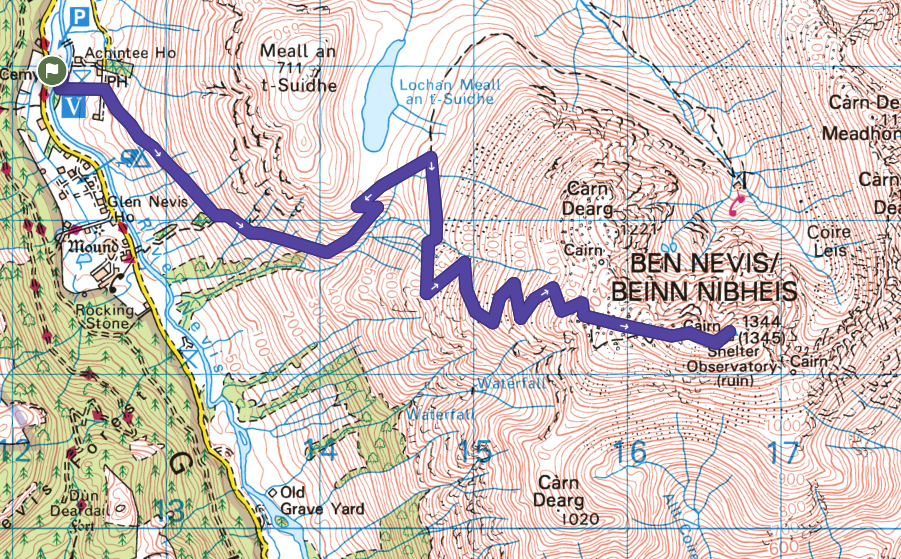
Ben Nevis
The route is long but generally simple to follow.
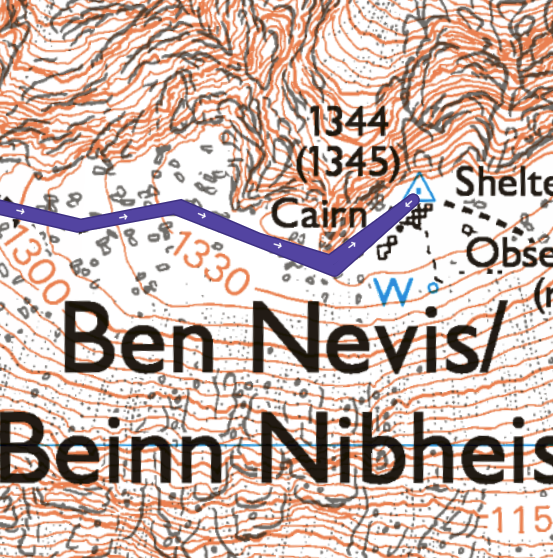
The Danger Areas
Be careful on the summit in poor visibility - take your time to find the ‘carins’ (very large piles of stones in this case) which guide you back to the track. This is where you should use your compass - from the summit, take a bearing of 231 degrees and follow it for 150m before taking a second bearing of 282 to get you back to the path.
People have had serious accidents where they’ve become disorientated in thick fog and walked off of ‘Gardyloo Gully’ - that’s why careful attention is needed to get off the summit in poor visibility.
Scafell Pike
Route: Brown Tongue from Wasdale Head
Distance: ~10km
Ascent: ~900m
Time: 3-5 hours
Shorter and steeper. This is often the most physically uncomfortable climb due to tired legs and rough ground.
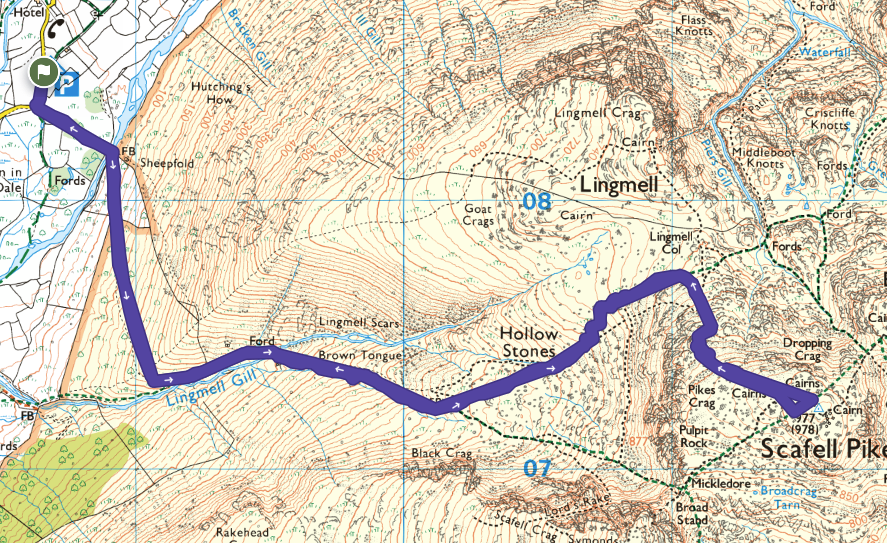
Scafell Pike
The route is again generally simple to follow - Lingmell Gill (stream) can be tricky to cross in bad weather.
Yr Wyddfa (Snowdon)
Route: Llanberis Path
Distance: ~14.5km
Ascent: ~975m
Time: 3-5 hours
The least technical and easiest to follow, especially at night.
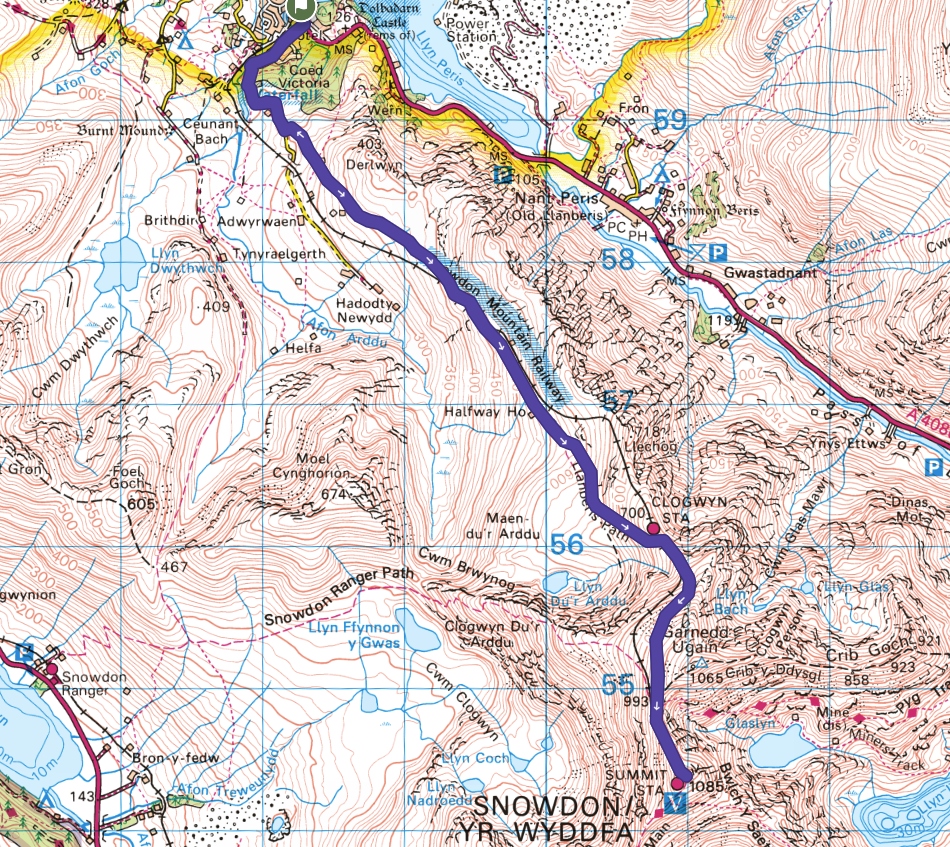
Yr Wyddfa (Snowdon)
This is the easiest route to follow. There are other routes you can take (e.g. Pyg Track) but this is the Llanberis Path is the most straight forward.
Logistics: the unglamorous reality
If you want to do this in under 24 hours - it really hinges on logistics. The walking is the easy part - the movement between mountains is where most plans start to unravel.
Below are realistic, sensible drive times in good conditions. These assumes brief stops and no major traffic incidents.
Typical order and drive times
Ben Nevis → Scafell Pike
Distance: ~460 km / 285 miles
Drive time: 5–6 hours
This is the longest and most fatiguing leg.
Scafell Pike → Yr Wyddfa (Snowdon)
Distance: ~210 km / 130 miles
Drive time: 3.5–4.5 hours
Often underestimated. By this point most people are heavily fatigued, dehydrated, and mentally dull.
Start times matter
To fit everything into 24 hours, most schedules:
Start Ben Nevis in the late afternoon or early morning
Reach Scafell Pike late at night or very early morning
Finish on Yr Wyddfa the following morning
Personally, if you’re doing this challenge in summertime, I’d rather start Ben Nevis very early (say 5/6am) so you can start Scafell Pike with as much daylight as possible. The route to the summit of Yr Wyddfa is so well marked and easy to follow - it’s the easiest one to do in the dark. Plus, you may get to view a mountain sunrise!
Vehicles and drivers
The biggest risk in the National Three Peaks is driving while exhausted.
Be honest about:
How many drivers you have - the more the better and I’d have at least one dedicated driver who doesn’t take part in the challenge. Ideally those taking part share the leg between Ben Nevis and Scafell Pike so the dedicated driver can rest - then they take the late hours shift to Yr Wyddfa.
Whether they can genuinely rest between legs.
Whether you’re willing to pause or stop if someone is unsafe to drive and possibly forgo doing it in under 24 hours.
If you only have one driver who’s also taking part in the challenge then you’re putting yourself and everyone else at risk - no challenge is worth risking everything for…
Parking and access
Car parks are not unlimited, especially at unsociable hours.
Check opening times and payment methods in advance (in particular the carparks near Yr Wyddfa)
Have a backup plan if a car park is full
Keep noise to an absolute minimum at night
You are arriving in real communities, not challenge venues.
Fitness: what you actually need
You don’t need to be super fit to this. I’d suggest most healthy people with reasonable walking fitness will have no problem completing every peak.
You do need:
The ability to walk uphill continuously for 2–4 hours
Reasonable downhill resilience (quads matter)
Enough conditioning to keep moving when tired and possibly wet/cold
Long hikes, steady hill days, and back‑to‑back efforts are far more relevant than HIIT workouts.
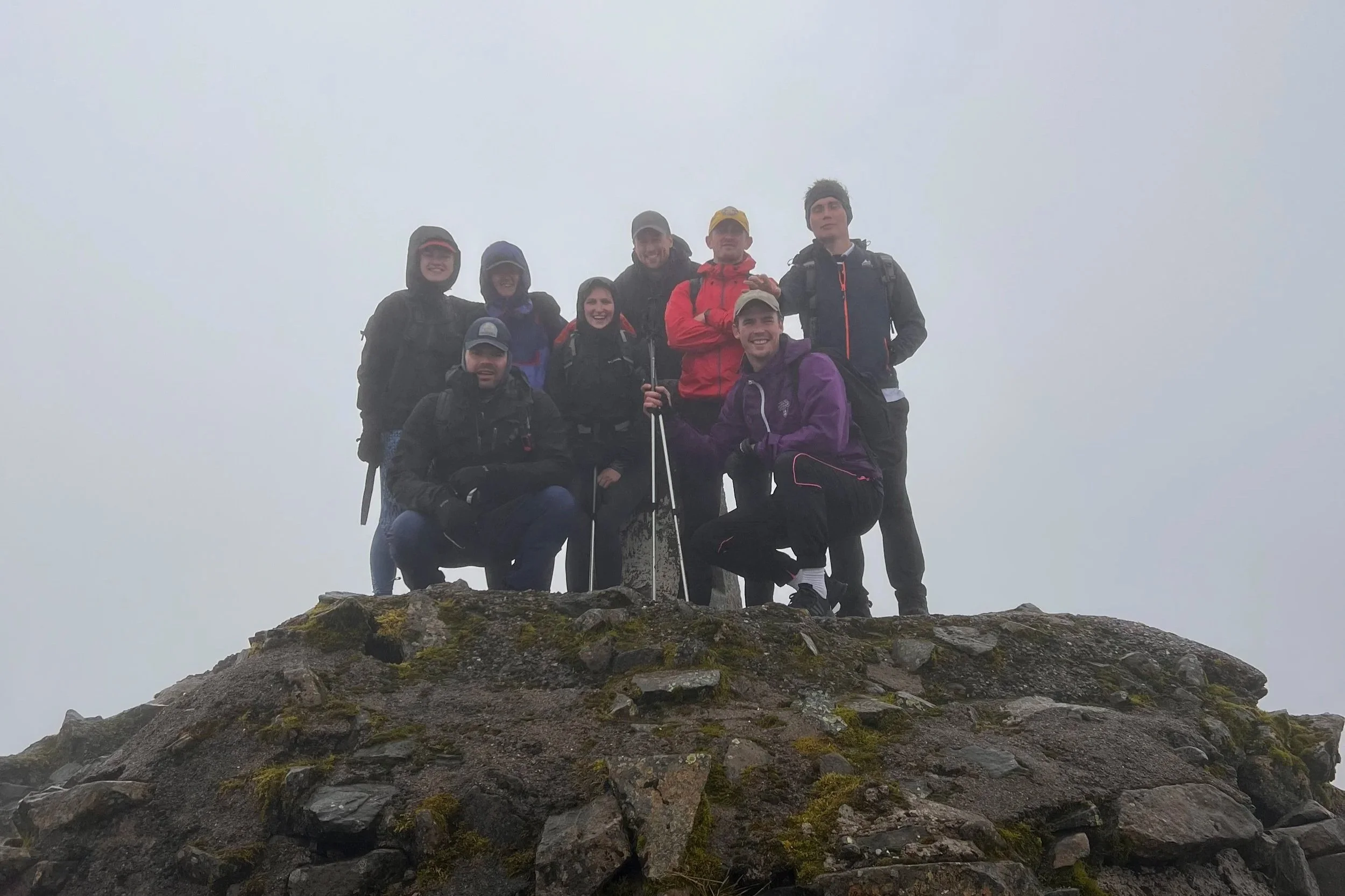
Ben Nevis Summit
The main risks
Most problems on the Three Peaks don’t come from the technicality of the mountains themselves.
They come from:
1. Sleep deprivation
2. Driving while exhausted
This is the single biggest danger of the challenge and is rarely talked about honestly.
3. Pressure to stick to the schedule / complete the challenge in under 24 hours
Weather deteriorates. Someone struggles. And instead of adapting, groups feel pushed to “just keep going”.
Environmental and community impact
The National Three Peaks concentrates large numbers of tired people into:
Honeypot paths (very popular, generally accessible and heavily used by visitors)
Car parks at unsociable hours
Fragile mountain environments
If you do attempt it:
Keep group numbers small
Respect local communities
Stick to paths
Leave no trace - I’d be willing to bet a lot of money you’ll find at least one ‘Monster’ can on at least one of the routes…
Loving the mountains means acting like guests, not consumers.
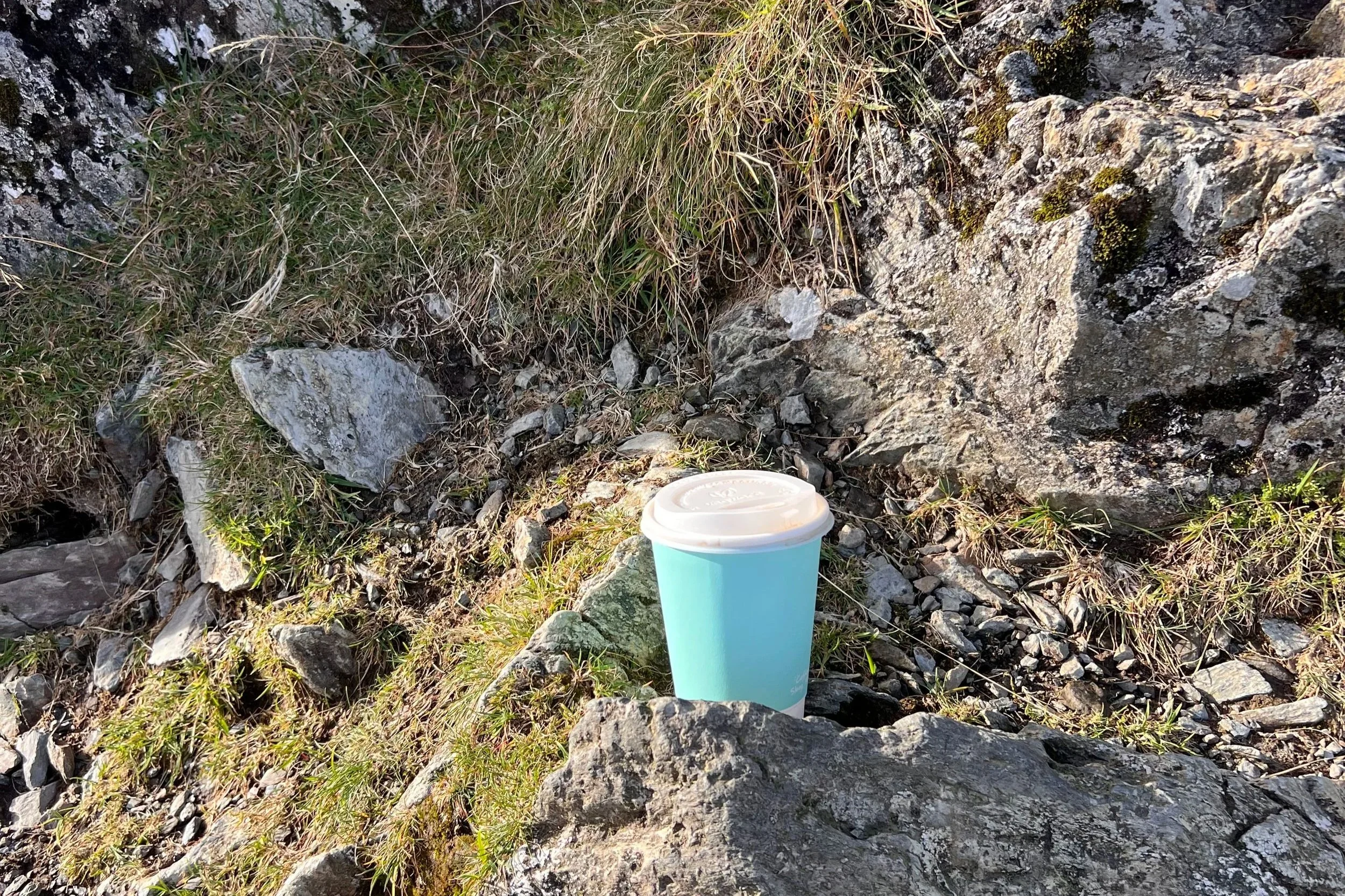
Abandoned Coffee Cup
The routes you go on for this challenge attract so many people - many with little knowledge or respect for the mountains.
If you’re set on doing it
If you really want to do it - take these steps:
Plan the routes - get a subscription or OS Maps or even AllTrails and study the routes.
Ensure at least one of the group has some mountain experience - someone should at least know how to get the group to the summits and have a plan on what to do if something does go wrong.
Pack light - you don’t need much in the summer but don’t forget key items like:
a. Headtorch - everyone should have one - phone torches won’t do!
b. Powerbank - if you’re following a route on your phone - it goes without saying you need to power at all times
c. Foil/emergency blanket - these are about £5, make sure everyone in your group has one
d. Whistle - if someone gets separated in the dark/fog - they need to be able to get someone’s attention
e. Waterproof jacket - make sure it’s a decent one
f. Blister kit - if you’ve not done an event like this before, it will be a shock to your feet
g. Dry kit for the car - you don’t need much, just something warm and dry for the drives - you really don’t want to sit in your wet stuff
h. Physical map and compass - you probably won’t need it but at least one person should carry this and know how to use it in case of very bad weather
Book accommodation near the start - anywhere in Fort William/Spean Bridge/even Glencoe is fine. There’s a hostel in Glen Nevis which is the classic accommodation for Three Peaks.
Source a driver - find a willing friend or family member who doesn’t take part but will do the hard driving.
Plenty of food/water - make sure you eat and drink plenty during and between efforts. You don’t need gels - just real food.
Planning and leading it yourself adds to the achievement and saves you a lot of money.
If you still want a guide to help you - ask for their help on individual mountains (i.e. one for Ben Nevis, another for Scafell etc.) - it will save you a load of money.
Why we don’t guide the National Three Peaks
At Jove Club, we try to avoid the overly commercialised experiences as much as possible.
For the cost of a Three Peaks challenge, you could do a ‘Jove Weekender’ where we teach you the skills needed to something like a TP challenge and the Welsh 3000s which is a much harder, rarer and more significant achievement, and you might still have money to spare…
£650 even almost covers one of our week-long Highland trips which are totally unique and a real adventure.
If you’re looking for challenges that prioritise experience, teamwork and memories over ticking boxes, that’s exactly what we build. Click the link below to see what we offer.