The Welsh 3000s: A Complete Guide (Route, Training, Kit & Tips)
The Welsh 3000s is one of the UK’s classic mountain challenges (and I think the best one): all 15 peaks over 3,000ft (914m) in Eryri (Snowdonia), completed in a single continuous journey. It’s big, committing, and hugely rewarding - equal parts fitness test, navigation challenge, and mountain day out.
This guide covers routes, logistics, training, kit, safety, and common mistakes, whether you’re planning your first attempt or sharpening up for a faster, cleaner round.
What Are the Welsh 3000s?
15 mountains over 3,000ft
3 mountain ranges: Yr Wyddfa (Snowdon), Glyderau, Carneddau
Typical distance: ~30 miles / 48km
Total ascent: ~4,000m
Time: 12–24 hours (conditions and fitness dependent)
The ranges are next to each other - meaning you can walk the entire way.
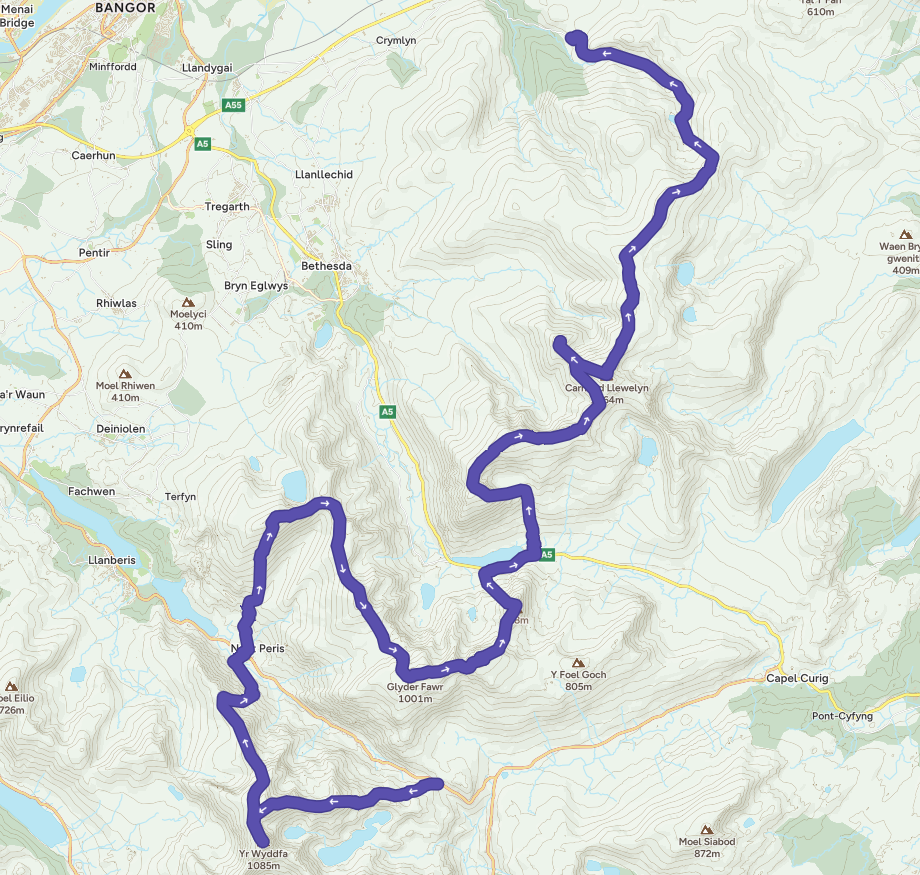
The Route
This gives you an idea of the scale of the challenge.
The 15 Peaks
Yr Wyddfa Range
Yr Wyddfa (Snowdon) – 1,085m
Crib y Ddysgl (Garnedd Ugain) – 1,065m
Crib Goch – 923m (most people start with Crib Goch)
⚠️ Crib Goch is a Grade 1 scramble with real exposure. Dry, calm conditions and confidence on ridges are essential.
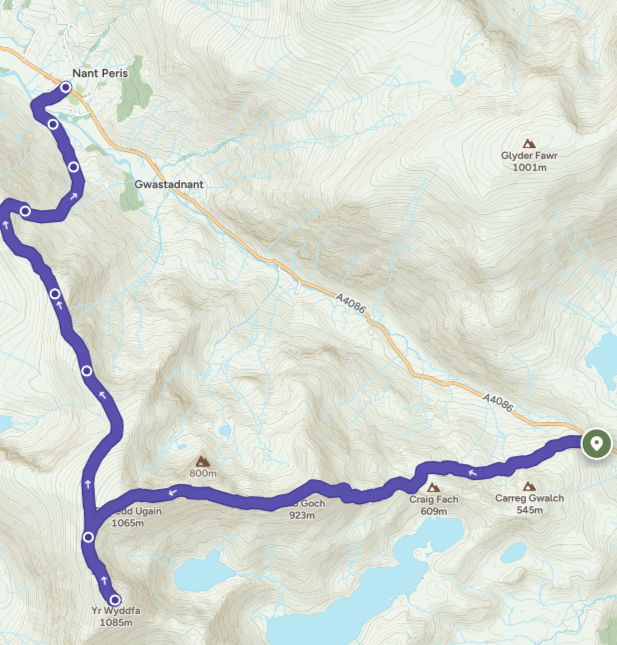
Yr Wyddfa Range
This is the most technical but also physically the easiest range.
Glyderau
Elidir Fawr – 924m
Y Garn – 947m
Glyder Fach – 994m
Glyder Fawr – 1,001m
Tryfan – 917m
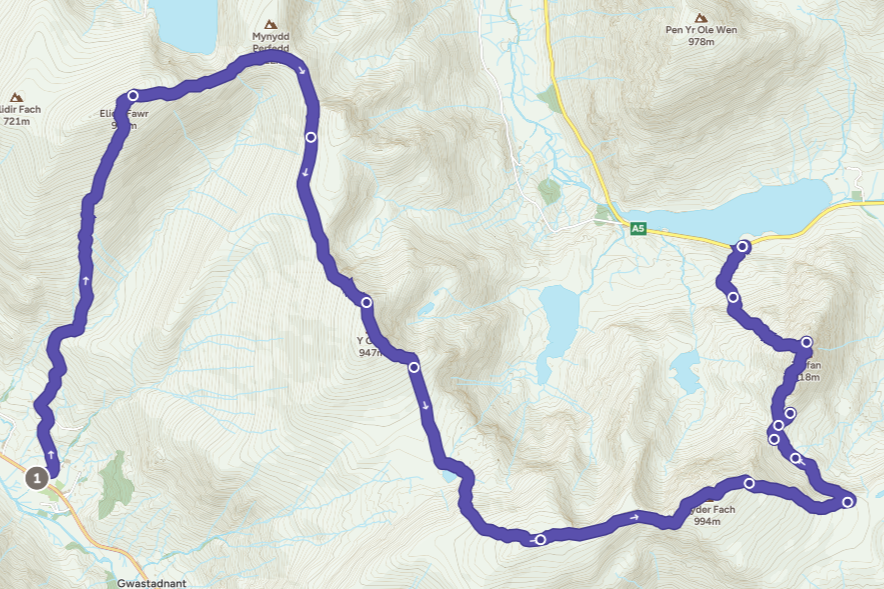
The Glyderau
I think this is the hardest range - lots of elevation, some tough ground and leg sapping descents.
Carneddau
Pen yr Ole Wen – 978m
Carnedd Dafydd – 1,044m
Yr Elen – 962m
Carnedd Llewelyn – 1,064m
Foel Grach – 976m
Carnedd Gwenllian - 926m
Foel-fras – 942m
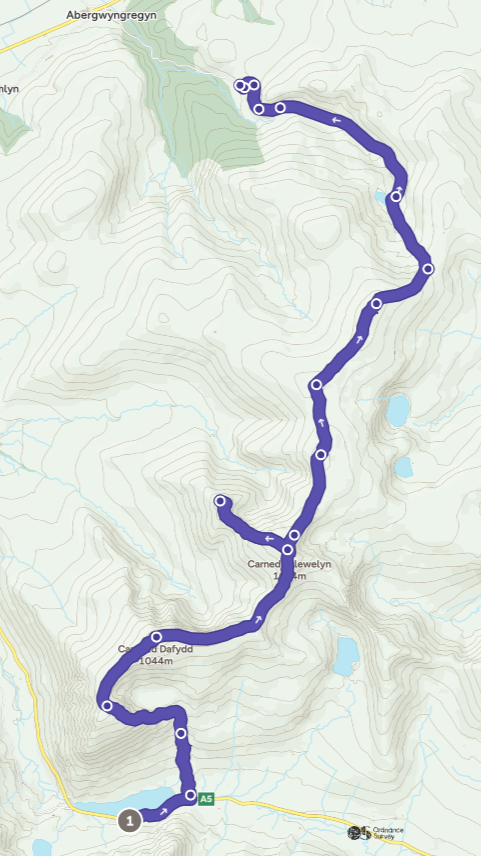
The Carneddau
In some ways, this is the easiest range - it’s not technical and only has one big ascent, BUT, it’s over a half-marathon in distance and you’ll have done a lot of work by this point.
Direction: South–North or North-South?
Personally, I prefer to start with the most dangerous/technical section first - Crib Goch. To do this, you’ll start at the Pen Y Pass carpark.
We’ll talk about kit and logistics later but I would strongly suggest wearing proper footwear for scrambling and maximum grip (i.e. not foamy running trainers!). Take your time with Crib Goch - it’s simple scrambling but very exposed at the point near the summit and highly consequential.
If you don’t feel comfortable - you can bypass it by taking the ‘Pyg Track’ or ‘Miners Track’ onto the summit plateau. These tracks run alongside Crib Goch and get you to the same level of elevation and the same distance - so it really doesn’t matter if you don’t feel able to take it on.
South → North (Most Popular)
Pros
Tackles Crib Goch early while fresh and importantly, on your own terms (in daylight with weather you’ve assessed).
Gradual terrain later in the Carneddau.
Easier navigation at night if you finish late.
Cons
Big climb straight out of the gate.
If you’re relying on any kind of public transport at the end, Aber Falls (where you finish) is pretty remote.
North → South
Pros
Long runnable sections early - you can cover a lot of ground while fresh.
You finish in more ‘civilisation’ - getting taxis/accommodation etc. is much easier.
Cons
Crib Goch late in the day when tired and possibly in the dark (not recommended!).
‘Goal line fever’ may encourage you to take a risk on something like Crib Goch even if you know the conditions (weather, strength of your group etc.) may have changed.
➡️ For first-timers, south–north is strongly recommended.
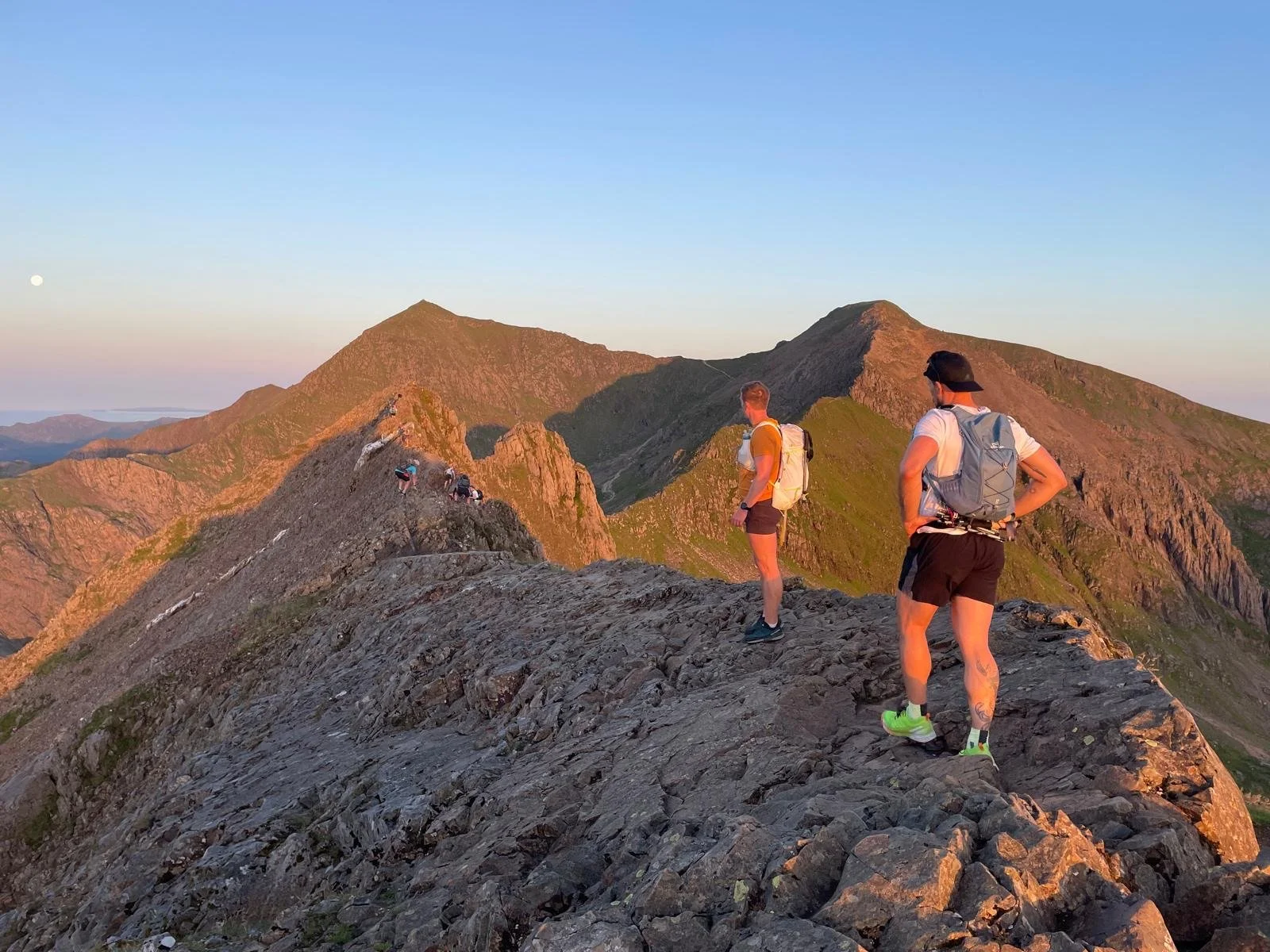
South to North
I strongly recommend starting with Crib Goch - this was at around 4.30am in July.
Key Descents (Where Most Time Is Lost)
Yr Wyddfa → Nant Peris: Steep and boggy grass slope - I fall over here at least once every time I do it. There also isn’t really a track so your route finding needs to be spot on.
Glyders → base of Tryfan: There’s a very unpleasant steep scree slope here which you need to take cautiously. It saps energy and unless you’re an experienced fell runner, it will slow you down a lot.
Tryfan → Llyn Ogwen: Another steep descent which take a long time to get down.
Efficient movement between ranges matters as much as the summits themselves.
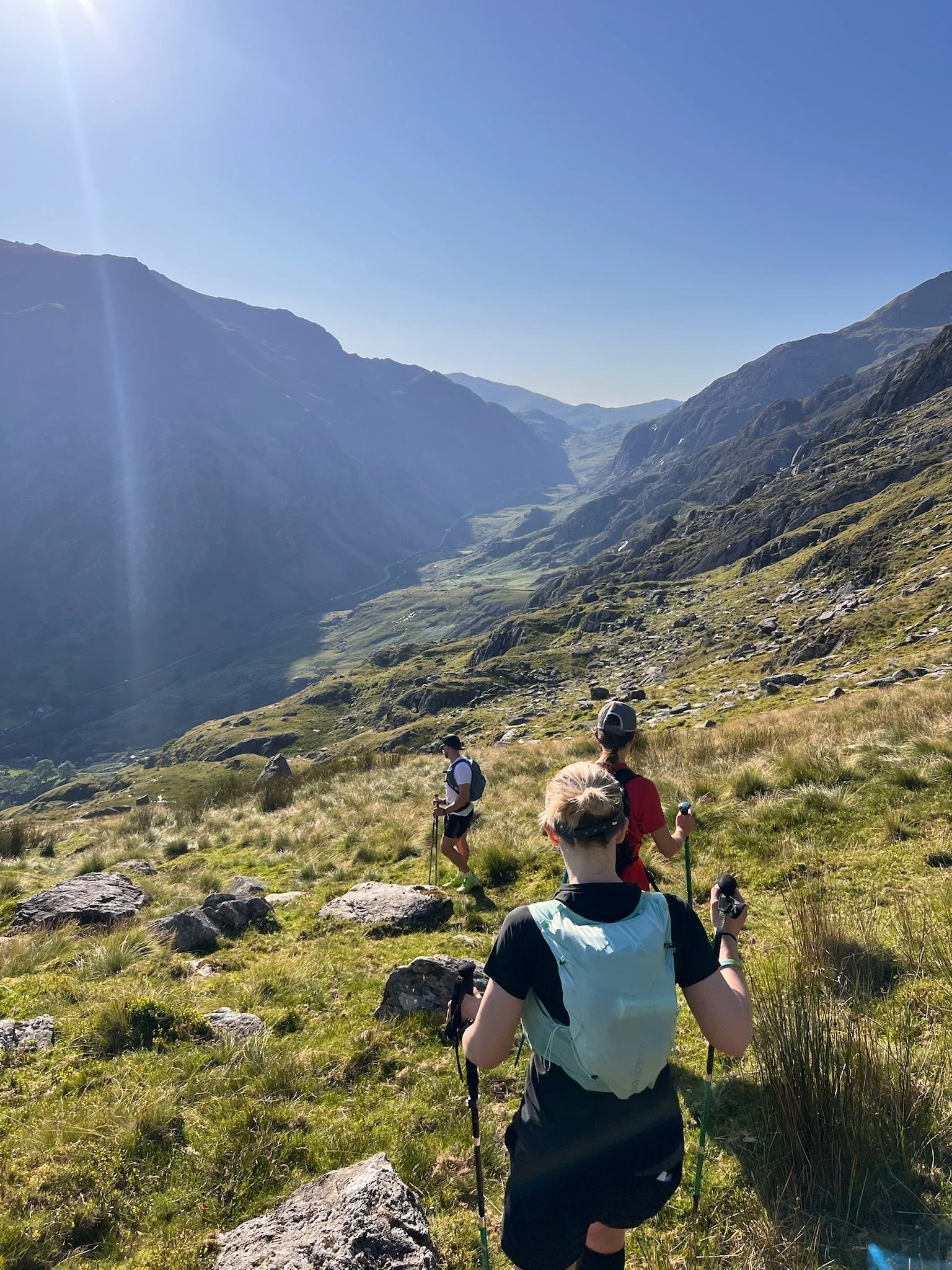
The First Descent
Some of the descents are very unpleasant and will take you a long time to complete.
Logistics
This is the sticky bit… I would strongly suggest asking a support person with a car to help you on the Welsh 3000s.
If you don’t, then you’ll not only have to stash water/food at the end of each mountain range which you probably don’t want to be doing the night before the challenge when you should be eating/resting and certainly don’t want to do it in morning of.
If there are a few of you with cars, an alternative is to leave a car with supplies at each stop… Again this probably isn’t ideal.
Pitstop 1: Nant Peris - this comes early in the journey after the Yr Wyddfa range. It’s a great change to get some proper breakfast as you’ll likely have started early.
Pitstop 2: Llyn Ogwen - you’ve got a while to go until you reach this! When you get there, have a proper meal. Pizza or sandwiches is ideal and make sure you rehydrate and refill all your bottles / snack supplies.
Finish: Aber Falls - the last range is really long… It might take as long as 8-hours to get to the end - a full working day. Make sure you’ve taken enough food/water with you to keep you going. Ask your support person to bring you some food/snacks/dry socks etc. to the pickup point.
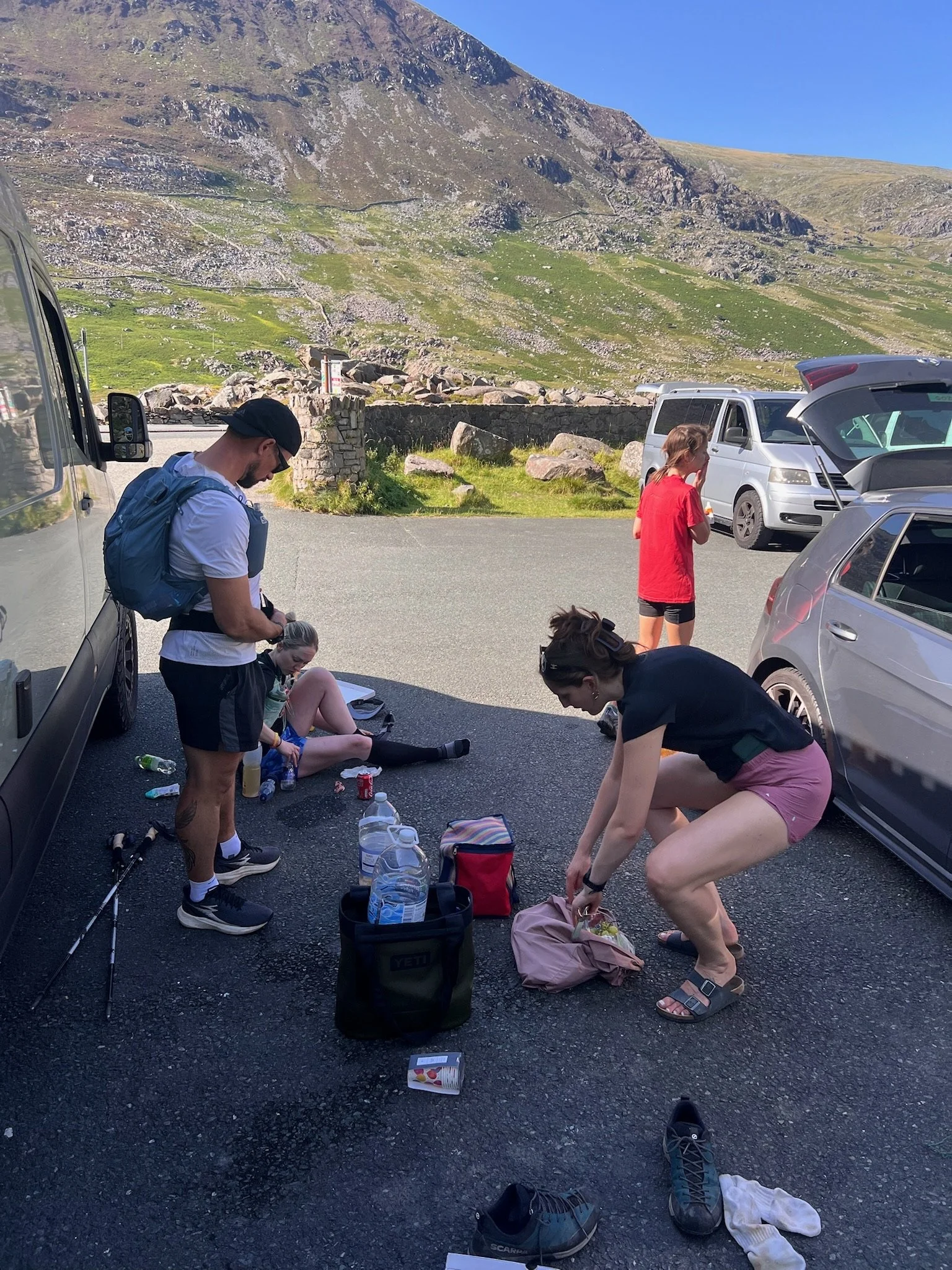
Llyn Ogwen - Pitstop 2
It’s really important to use these as opportunities to sort yourself out, eat proper food and change into some spare kit if need.
How Fit Do You Need to Be?
Of course any ultra-running/hiking experience will set you up really well for this. However, you don’t need to be an ultra-endurance athlete to do this. What you do need is:
Comfort (experience…) moving for 12+ hours - this could be closer to 24 hours and very often is.
Strong legs going uphill - this can be hard to train if you don’t live near hills but it’s possible to do what you need in London. I live in London and so do most Jove Club people who come our version of this event.
Durable legs for long descents - controlling yourself on the downhill sections can be more taxing than going uphill.
Experience scrambling - despite what social media says, you don’t have to be a mountaineer to get across Crib Goch… But I would strongly suggest getting in some easier scrambles before you take this event on. If your first time putting your hands on rock or experiencing any kind of exposure is on Crib Goch, then it might come as a shock to you.
I think a really good benchmark is if you can string together a couple of 10/12 hour hiking days (don’t worry too much about distance) then you’ll be fine.
Fitness Training for the Welsh 3000s
So with that in mind, let’s talk about fitness training. If you don’t live in the mountains - don’t worry, you can still get fit for this event! At Jove Club, a huge part of our business is coaching and preparing people for epic adventure challenges like this.
Although physically very challenging - we prepare for this in the same way we prepare for any adventure. We prioritise three aspects of adventure fitness:
1. Resilience / Robustness
This is priority number one - if you’re ever in doubt what to do in your session, refer back to this!
What does it mean?
Firstly, you must remain injury free - it doesn’t matter if you can run a 1h 30min half if you’re broken when it comes to the challenge. Always remember why you’re training and you’ll hopefully keep on track.
At the time of writing, I’m training for various events but I have a bad knee - so I’ve immediately stopped running (subbed it for cycling) and also stopped any serious weight training that relies on my knees (squats, lunges etc.) - there is literally zero point in me getting fitter for a race if breaks me and means I can’t get out and do the things I want or in the case of leading trips - need to do.
Secondly, part of being resilient and robust is being able to operate in the elements. I tell people this until I go blue in the face - people who live in cities (like I do) spend far too much time indoors.
If you work in Canary Wharf (which I did for a year or so) for example in London, you can literally spend your entire working week under cover apart from the hop to the tube or supermarket. This is what breaks people in the hills as much as fitness - the conditions change and people lose functionality.
Nice plush gyms make nice soft people…
You need to be hardier to do an event like this.
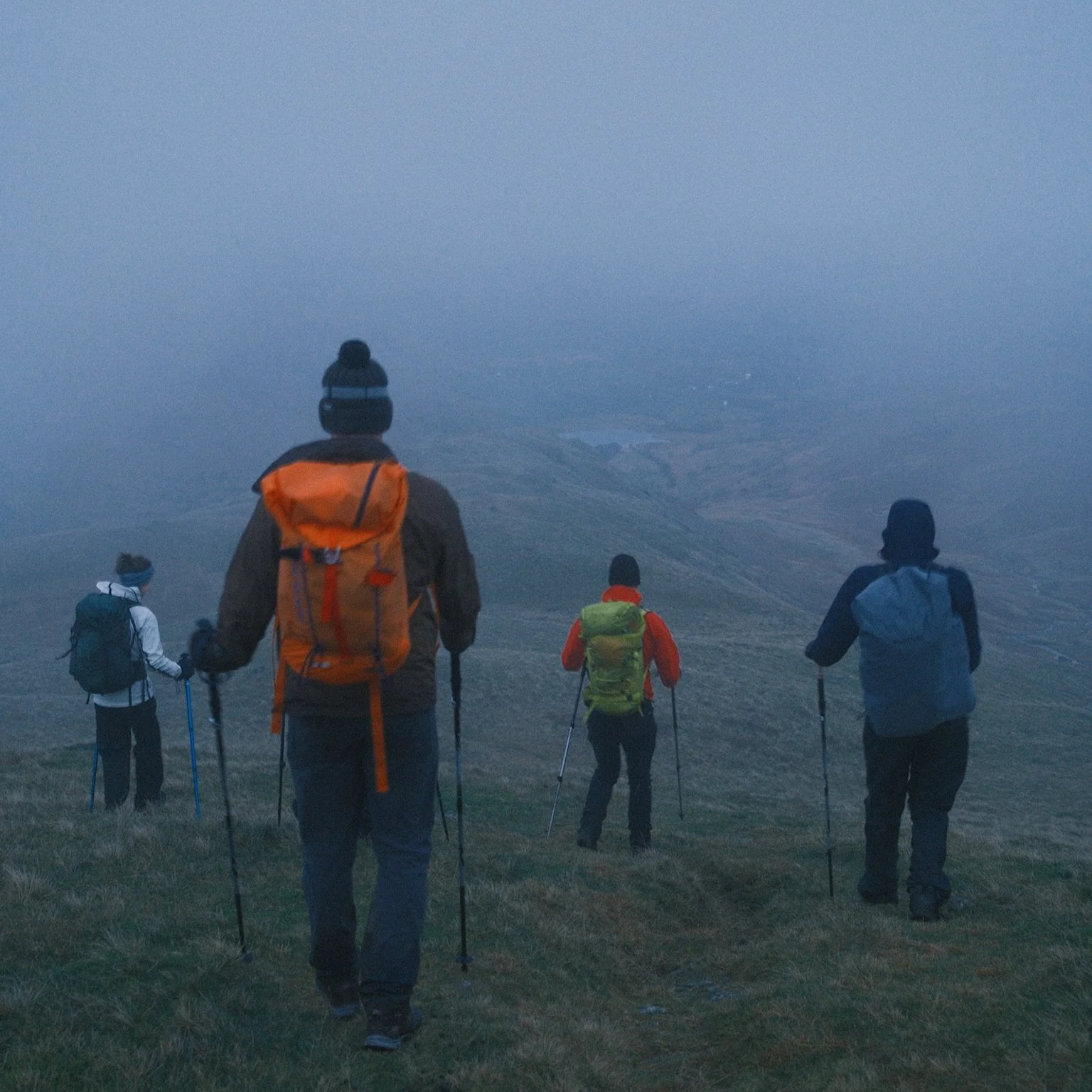
Weather Plays a Role in Your Welsh 3000s Success…
If you’re the sort of person who reads something like this then I probably don’t need to tell you the weather can be bad on mountains!
2. Aerobic Conditioning
I would strongly recommend basing your aerobic training on running. It replicates the demands of hiking really well and you can do it anywhere. You don’t need to take a bike with you, find a swimming pool or head to a gym.
There are also so many running races these days - you can always be signed up to something to keep you motivated.
As a baseline, almost regardless of what adventure activity or race you’re training for, do the following every week:
One or two easy runs (build up distance to no more than 60 mins)
One tempo run (running faster)
Hill sprints or speed work (sprints/strides)
One long run - this is probably the most important. You don’t need to go quickly, just build up the distance week on week.
I know what some people will be saying… ‘you don’t need to do speed work to get fit for the mountains’. It is true that most elite mountain athletes don’t do much outside of ‘Zone 2/3’ training but you have to remember, many of these people live in the mountains and can spend multiple hours every day running/hiking at a steady pace.
It’s highly likely you can’t do that…
Speed is training is not comfortable - which is a good thing when you’re trying to forge a strong mindset.
3. Strength Training
The first goal of strength training is to keep you injury free - not cause pain! If you’re pushing so hard on trying to get a 200kg deadlift that you keep getting injured, you should re-assess your priorities… Are you just training for the Welsh 3000s or are you really training to get a good deadlift? You should try and build some muscle - yes you heard me correctly. You don’t need to be a bodybuilder but muscle mass helps prevent injuries and keeps you robust.
The next goal is to support your aerobic training - in this case running. It doesn’t matter what your squat is if your engine isn’t up to the challenge which why everything should be geared towards supporting that.
I would do 2 or 3 total body sessions per week. Focus on legs and core primarily but train everything.
Do at least one session where you focus on muscular endurance - circuits are great for this!
Adventure Preparation for the Welsh 3000s
1. Research
As you’re doing now, do some research. Watch YouTube videos, speak to people who’ve done it before. It’s important to understand the challenge.
Study the route. Don’t just read this, download AllTrails and head to the start line… Get the correct mapping (OS Maps or Harvey Maps) and learn how to interpret it. Mentally it’s really important to understand each phase of the route and what the terrain will be like.

Research, Research, Research!
If you’re doing this unguided - the more you know the better your chances of success!
2. Build Experience
If you’ve already spent a lot of time in UK mountain conditions, you’re probably good here! If not - it’s important to build up to something like this. It’s not just about being fit as discussed earlier - you need to be comfortable navigating/ route finding, you need to know how to fuel yourself and use your kit.
Also, have a go at some Grade 1 scrambles. North Wales is excellent for low grade scrambling. Buy a guidebook and them a go. A perfect place for beginners is Moel Siabod via the Daear Ddu ridge - you bypass much of the scrambling if you really don’t feel comfortable and the exposure is limited.
3. Practice Sections
For this, if you want to self-guide, I would strongly recommend trying some aspects of the route slow-time (e.g. Crib Goch). They’re all great days out in their own right and will give you plenty of confidence going into the challenge.
4. Test Your Kit
As an example, Crib Goch isn’t hard at all if you can truly trust your kit/shoes. How do you build trust in your footwear? Get out onto rock as much as possible. I get people to stand on non-consequential (meaning if they fell, they wouldn’t get hurt) but steep rocks/slopes to test the limits of their footwear.
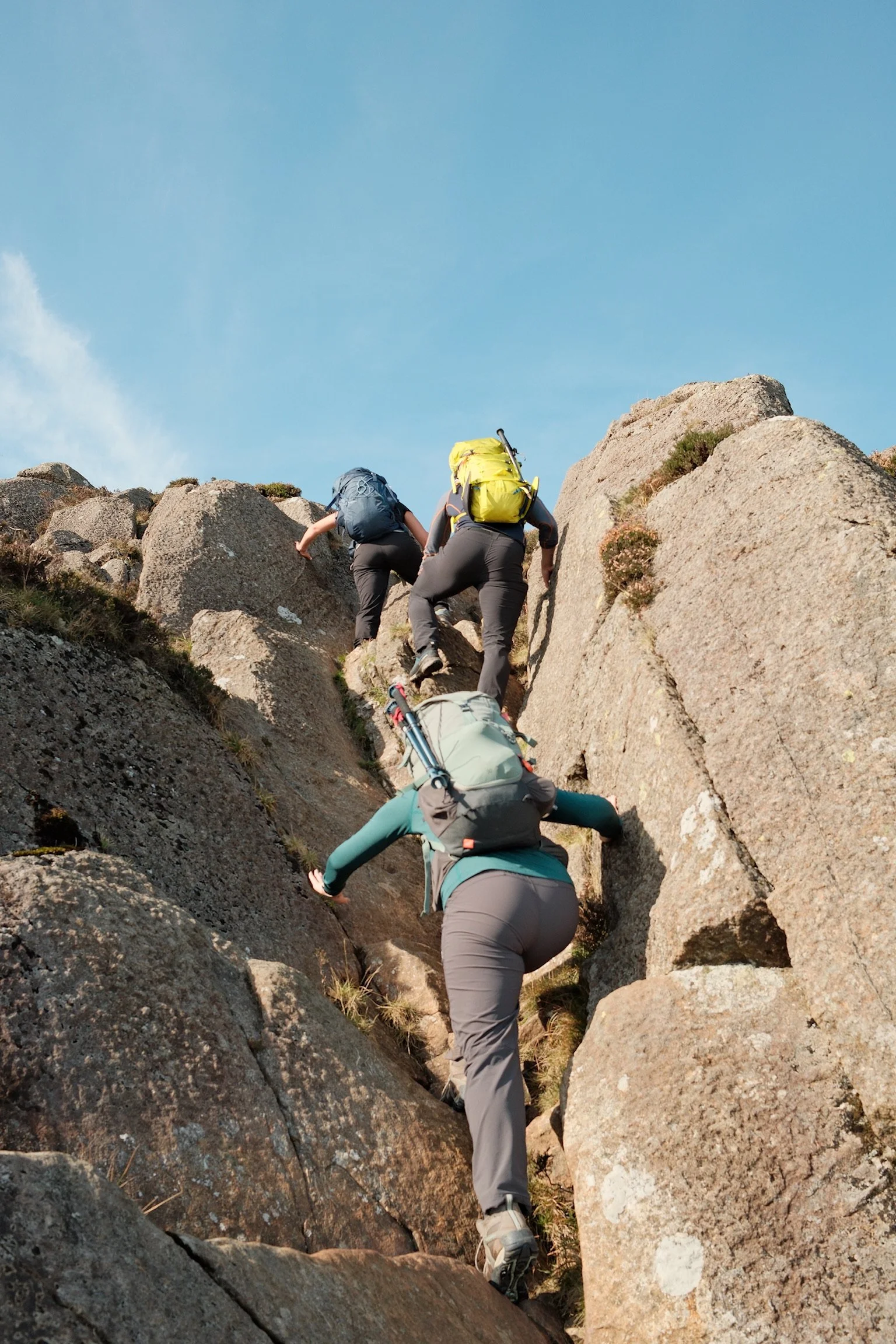
Moel Siabod via the Daear Ddu ridge
This is an excellent grade 1 scramble if you’re a first timer - it’s not exposed, easy to follow and you can bypass the scrambling sections if you don’t feel comfortable.
Kit List
Travel as light as possible within reason.
Essentials
Approach shoes for Crib Goch at least - there will be times on that ridgeline where you’ll be relying heavily on your footwear and big spongy trainers are really not ideal unless you’re already very experienced.
You can switch to trail shoes if you want at one of the pitstops.
Waterproof jacket - I recommend ‘Goretex’ but not a ‘running jacket’ - get one for the mountains from a brand like Mountain Equipment, Rab, etc.
Shoft-shell jacket - something thin to wear if it’s not raining that will keep the wind off.
Headtorch and spare + spare batteries
~20-30L rucksack
Map & compass
Phone + GPX
Charging block
Small first aid kit with foot care
Group shelter if with others - why? The last range is actually very remote and not close to a road. If some twists a sock, and the weather is horrific, you’ll really appreciate a shelter while you wait for rescue!
Foil blanket
Gloves & hat (even in summer)
Cap
Sunglasses
Suncream
Layers
Walking poles - anyone who thinks these are ‘just for old people’ is a certified idiot… They reduce the burden on your legs by 25-30% so why wouldn’t you take them?? Some of the best ultra-endurance mountain athletes do every event and race with poles - so much so, ultra-running vests have a collapsable pole holder.
Optional - spare kit for the pit stops. Anyone can be wet and cold… Take a couple of spare tops, perhaps a spare pair of trainers and some socks.
Nutrition
Eat every 45-60 min - can be whatever you like, sweets, flapjack - whatever worked for you in your preparation
Try and get a bigger feed at each pitstop
Electrolytes
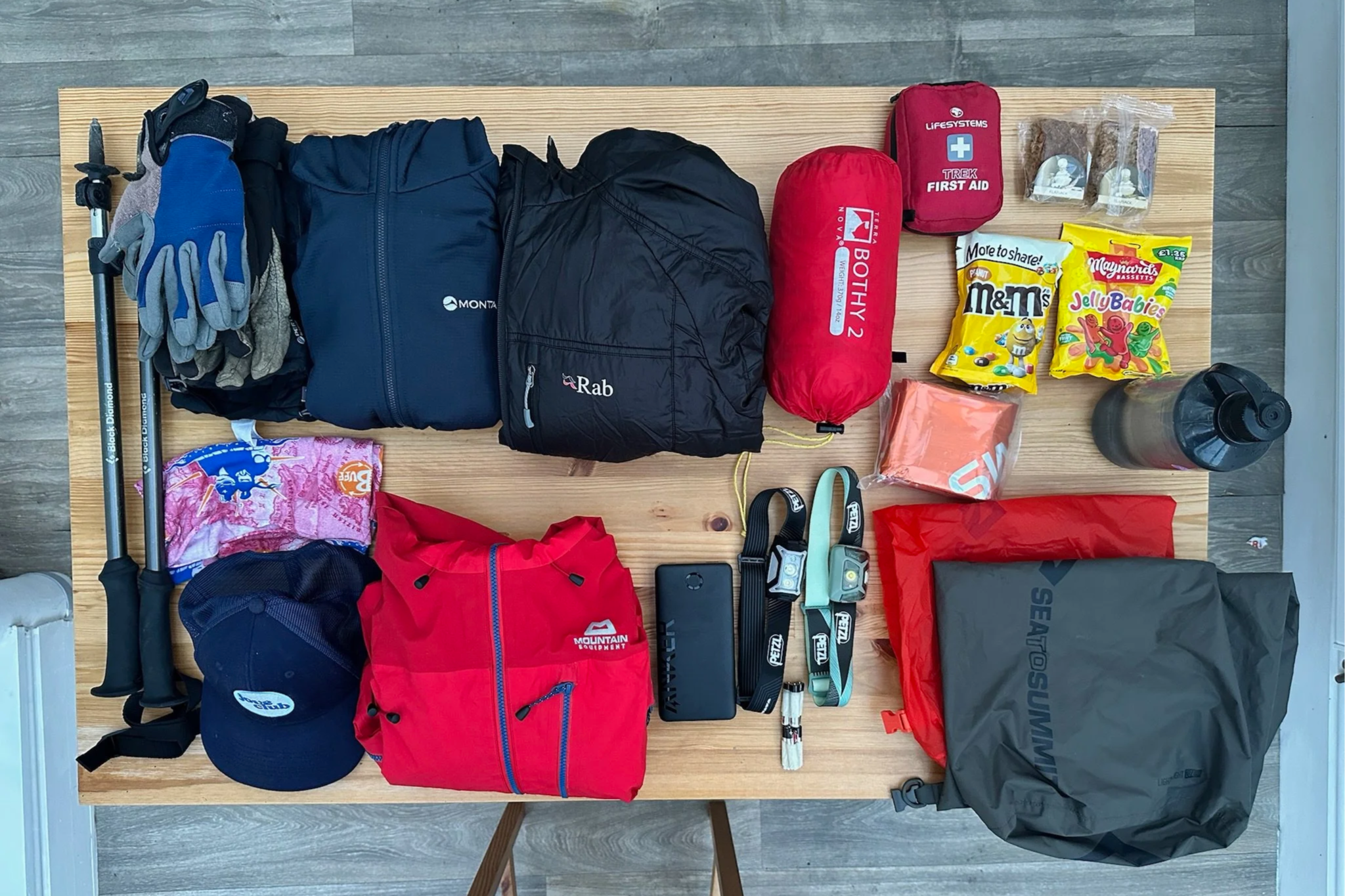
Get Your Kit Right…
This was my kit for a solo winter Welsh 3000s in February 2025 - it wasn’t ‘winter condition’ (i.e. snow/ice) - your kit should be similar to this even in the summer unless it’s an exceptionally hot day. Note even though I was solo, I still packed a shelter!
Weather & Conditions
Eryri can deliver four seasons in a day.
Think twice if:
High winds - anything above 25-30mph is very dangerous on Crib Goch.
Extreme rain - you can crack on in most variants of rain but it depends on your experience and kit. I would avoid Crib Goch in very heavy rain.
Named storms - I’d avoid doing it all together.
Always check:
MWIS (Mountain Weather Information Service)
Met Office mountain forecast
Safety & Ethics
Tell people what you’re doing and what your route is etc. Hopefully you’ll have a support person/crew so they should be tracking you in case of emergency.
Take the emergency kit listed - I’ve spent hundreds of days in the outdoors and never had to use it - but there’s no way I’d want to be caught short in an emergency situation.
There is zero shame in turning back/bailing at a checkpoint. If conditions have changed or your exhausted, it makes no sense to commit to another big range.
Respect the mountain and others - I see so much litter on the mountains in Eryri which is infuriating. No one is coming to clean up after you! Just because you’re tired - it doesn’t give you an excuse.
If something looks wrong and feels wrong, it probably is! This is my golden rule for almost anything in life but certainly for the mountains. Sometimes it’s good to trust your gut instincts especially if you’re not overly experienced.
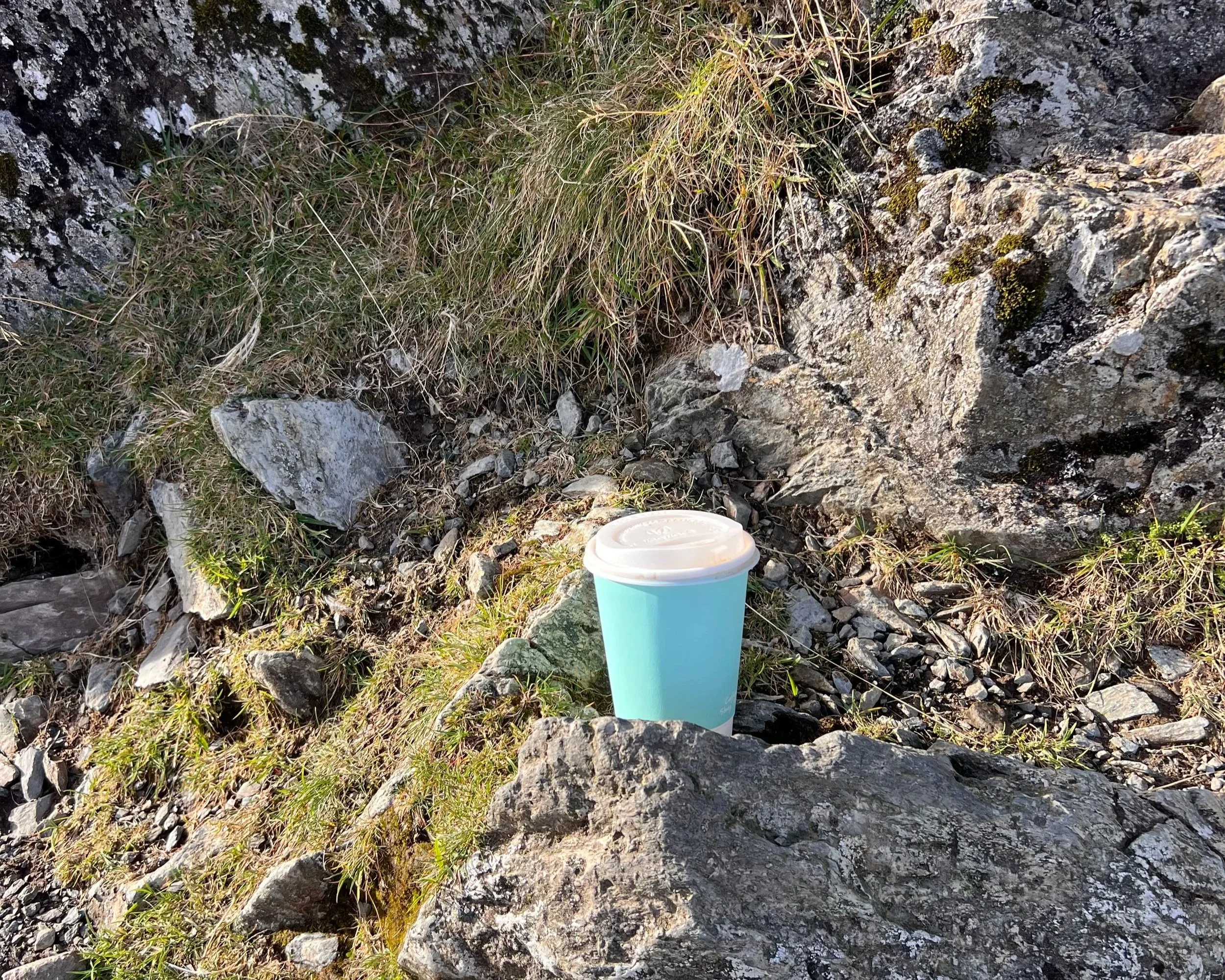
Leave no Trace
Don’t be like this person… No one is able to clean up after you.
Common Mistakes
Starting too fast - take it easy. Another reason why Crib Goch is a great place to start - it slows people down!
Under-fueling at the start - even if you don’t feel hungry/thirsty, keep eating/drinking! It’s not a place to diet.
Poor transition planning - the pitstops are great, but don’t spend long there! I’d suggest 10 min for Nant Peris and no more than 20/25 min at Llyn Ogwen. Time is against you from the off.
Attempting Crib Goch in bad weather - just because ‘big mad mountain man Andy’ from the hostel tells you he’s going up in 40 mph winds, it doesn’t mean it’s okay! Make your own assessment taking into account weather, the condition/fitness of you and your group - do not be guided by the fact ‘he’s doing it, so that means it’s fine…’.
These are called ‘heuristic traps’ and this one in particular is known as ‘Social Facilitation’ - it’s probably the most common form of heuristic trap in a challenge and area like this. North Wales is teaming with wannabe influencers desperate to make the most of their opportunity to film some content - don’t follow them if you know deep down it’s wrong.
Forgetting spare kit - this is so simple but will make your day so much better! Dry socks are a godsend.
Not having a support person - I think this is so important to making the day a success. It takes so much pressure and stress off of you.
Should You Go Guided?
Of course, we’re going to be bias here… But I would strongly suggest doing this challenge guided if you want maximum chance of success.
Why?
Firstly, this challenge is so much better with others - I’ve done it solo once and it’s pretty bleak at the end. It can be hard to find people to do it with! Leave that to us/the company you use to take you.
Secondly, navigating, pacing, judgement, coordinating the admin isn’t easy - even for experienced mountain instructors! Decision making is challenging for this kind of event and so doing it guided means all you have to think about is walking.
Finally, we put this trip together as a package and you’ll probably find the price is comparable to you booking accommodation, hiring a support car (if you don’t own one) and buying food for resupplies.
Final Thoughts
The Welsh 3000s is a brilliant event for UK mountain lovers! It rewards preparation, patience, and respect for the hills. Done well, it’s not just a challenge - it’s a brilliant journey through some of Eryri’s finest terrain.
If you’re training for it, enjoy the process. The mountains will still be there.
If you’d like help with this - training plans, recces, or guided attempts - that’s exactly what we do at Jove Club! Checkout our next trip.