By Freddie Sankey · Founder of Jove Club
Strength training for the outdoors: what matters and what doesn't
Most gym advice is aimed at people who want to look better. If you want to move well in the mountains, what you need is different, and simpler.
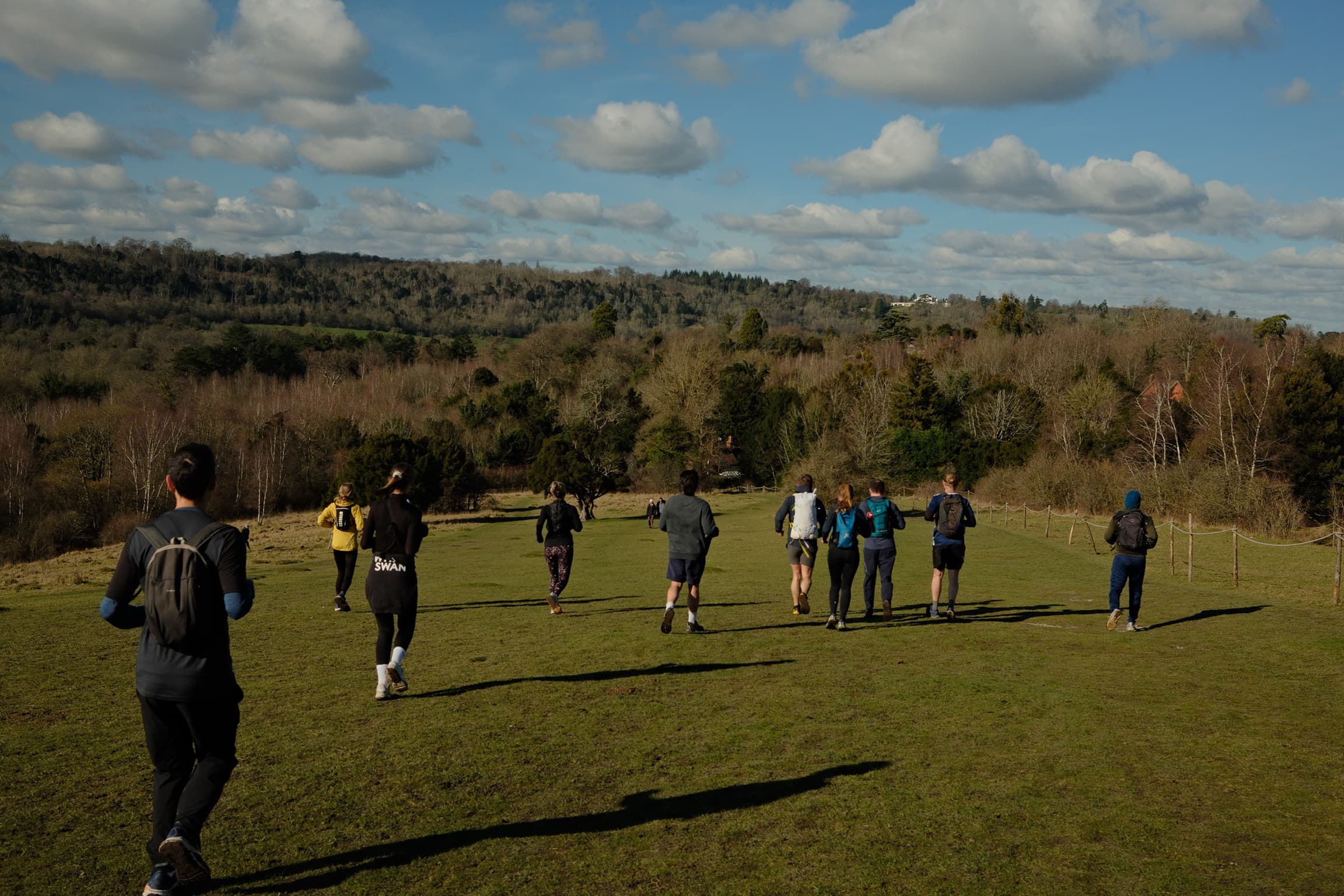
Strength training for adventure isn't complicated. You're not training to be a bodybuilder, a powerlifter, or an Olympic weightlifter. You're training to move well under a pack over long distances on difficult terrain, to be able to react quickly when footing is uncertain, and to not be wrecked for three days after a long day in the hills.
That changes what you need to prioritise, and what you should probably ignore.
Train the whole body, every session
Bro splits, chest and triceps Monday, back and biceps Wednesday, legs Friday, are designed around aesthetic goals. You want balanced muscle development across a week, prioritising the muscles people see.
That's not what you're after. Adventure demands integrated movement: carrying loads on your back, climbing over obstacles, maintaining posture for hours while tired. This requires strength across your whole body working together, not isolated muscle groups trained independently.
Do whole-body sessions. Hit legs, upper body push, upper body pull, and core in every workout. The frequency is lower per muscle group, but the movement pattern is more athletic and the training is more time-efficient.
Focus on compound movements
Compound movements, exercises that involve multiple joints and multiple muscle groups, are the foundation. Squats, deadlifts, lunges, rows, pull-ups, overhead press, hip hinges. These movements build functional strength, work large amounts of muscle simultaneously, and transfer directly to how you move outdoors.
Single-joint isolation exercises (bicep curls, leg extensions, lateral raises) have their place, but they're not the foundation. If you only have limited time to train, most of it should be on compound movements.
Skip the complicated movements
Olympic lifts, snatches, clean and jerk, muscle-ups, are excellent training tools. They also take a long time to learn properly. Months of technique work before you can load them meaningfully, and years before you're proficient.
If you're training for adventure and not for sport, the time cost of learning complex movements is not worth it. The same stimulus is achievable with simpler exercises that you can load progressively from session one. Use the time to train, not to drill technique on movements you may never master.
Superset to save time
Supersetting means pairing two exercises back-to-back with minimal rest. While your legs recover from a squat set, you can do a set of rows. This cuts total gym time significantly without reducing training quality, in some cases it improves conditioning.
A practical approach: pair a lower body push (squats, lunges) with an upper body pull (rows, pull-ups), and a lower body pull (deadlifts, hip hinges) with an upper body push (press-ups, overhead press). Core exercises can fill the gaps between sets. A full whole-body session can be done in 45-50 minutes.
The 48-hour rule
Don't strength train the same muscle groups on consecutive days. Strength training creates microscopic damage in muscle fibres, that damage is repaired during recovery, and the repair process is what makes you stronger. This takes roughly 48 hours.
Training before that process is complete disrupts the adaptation and increases injury risk. Two or three whole-body strength sessions per week, spread across the week, is optimal for most people. Three days of rest between sessions is fine. Four or five is too many sessions for the volume to add up to much.
Don't use soreness as a measure of a good session
DOMS (delayed onset muscle soreness, the soreness that peaks 24-48 hours after training) is not a reliable indicator of a good session. It's an indicator of a novel or unusually high stimulus. Experienced lifters get very little DOMS even from hard sessions, because their bodies have adapted.
Chasing soreness leads to constantly changing your programme to create novel stimuli, which prevents the progressive overload that actually drives progress. A session can be excellent without producing significant soreness. Train consistently, progress systematically, and don't read too much into how sore you are two days later.
What strength training achieves for adventure
The practical benefits are specific. Leg strength reduces fatigue on long descents, the eccentric loading of walking downhill is where untrained people feel it most. Upper body strength makes scrambling more comfortable and gives you something in reserve for technical terrain. Core strength maintains posture under a loaded pack, reducing back and hip fatigue on long days.
None of these outcomes require an advanced programme or a lot of time. Two whole-body sessions per week, consistently applied over a few months, produces clear and noticeable improvement in the mountains.
“You don't need a complicated plan. You need a simple plan done consistently.”
Jove Club
Train for the outdoors, not the mirror.
Jove Club's training programme is built around whole-body strength and adventure fitness, not aesthetics.
See the training programme
Freddie Sankey
Founder of Jove Club
Freddie founded Jove Club after six years as a Royal Marines officer and six more in finance. He's a qualified outdoor instructor and running coach, guides many of the Jove trips himself, and trains with the group in London every week. In his spare time he's drawn to mountaineering, physical challenges and multi-day adventures.
More about Freddie →
Ready for the real thing?
See what trips are coming up.
Guided by qualified instructors. Small groups. All abilities.
Browse trips